![[tel]020 7433 1863[tel]](http://www.lilyskitchen.co.uk/cdn/shop/files/contact.svg?v=1747219162&width=32)

Your puppy’s diet is essential to help support their growth and development. Here you’ll find our puppy feeding guide – from understanding their needs to choosing the right food and giving your little bundle of fun all the nutrients they need to grow into a healthy, happy dog.
"PUPPYHOOD IS THE MOST NUTRITIONALLY DEMANDING TIME IN A DOG'S LIFE"
PUPPIES GROW QUICKLY
Puppies grow quickly in the first few months, so puppyhood is the most nutritionally demanding time in their life.
Small-breed dogs usually reach physically maturity at an earlier age than large or giant breeds, who will reach their mature body size later. Because of this, you may need to feed your smaller breed puppy food until one year of age, while those with larger breeds may need to feed their dog puppy food for a little longer. Discuss with your vet to identify when the right cut off point is for your particular breed.

YOUR PUPPY’S NEEDS
Whatever their breed, because they are growing so fast, puppies have a higher requirement for protein, energy and calcium than an adult.
Along with their exercise, diet has the greatest effect on your puppy’s bones and joints, and thus their size, shape, strength and fitness as an adult.
If your new pet is coming from a breeder, it’s most likely they will have been weaned before you go to collect them. Weaning tends to occur at around 4-8 weeks and is where the pups start to rely less on their mother’s milk and puppy food is slowly introduced. Our dry and wet puppy food is for puppies 8 weeks+. If at this stage, you are still weaning, remember to introduce the puppy food gradually and only use tiny amounts. For weaning puppies, if you decide to feed your puppy dry food, you should always soften the kibble by soaking it in warm water for a minimum of 30 minutes until it gives the consistency you desire, allowing it to fully hydrate. You may also want to mash it down further with a fork. Ensure the food is cool before allowing the puppy to dig in.
If your pup is happily enjoying their food with ease, you can build this into their daily feed. However, remember pups only have tiny stomachs and so little and often is the best approach.
Young puppies need to be fed a diet that has been specially formulated for growth, so it’s important to choose a diet that is labelled as being ‘for puppies’.
“FROM BIRTH UNTIL THEY REACH 50% OF THEIR ADULT WEIGHT, YOUR PUPPY WILL HAVE AROUND DOUBLE THE DAILY ENERGY REQUIREMENTS OF AN ADULT”
WHEN AND HOW OFTEN SHOULD I FEED MY PUPPY?
Puppies have small stomachs and a high metabolic rate, so need to be fed little and often. At around three to four months of age, we recommend feeding them three to four meals a day, and this can be gradually reduced down to twice daily feeding by the time they’re around five to six months old.

WHERE SHOULD I FEED MY PUPPY?
We recommend feeding your furry friend in a quiet, accessible area where they won’t be disturbed and can chow down in peace. This is especially important if you have any other pets – wait until they’re all used to each other before feeding them together.
SHOULD I FEED MY PUPPY WET OR DRY FOOD?
Unless your vet has discussed feeding your puppy a special diet, both types of food can provide nutritionally balanced diets. However, each one has their own benefits and drawbacks. It’s up to you as the pet parent to make the right choice for your puppy.
Benefits of dry food: Dry food doesn’t spoil when left out as quickly as wet food does – which is great for dogs who graze.
Benefits of wet food: If your puppy is teething, wet food may be a gentler option. You can also warm it slightly to help avoid any pain from cold food.
MAKE PUPPY FEEDING CHANGES GRADUALLY
It’s a good idea to stick with the same food that your puppy arrived with, (the same that they had at the breeder), for at least the first few weeks before gradually changing them onto a diet of your choice.
Always make any dietary changes gradually. Sudden changes to the diet can cause tummy upsets. So, if you are either changing to a different recipe or changing to a new food, do so gradually over a minimum of 9 days.

“CHOOSE HEALTHY TREATS FULL OF NUTRITIOUS INGREDIENTS”
HEALTHY TREATS FOR PUPPIES
Obesity is a huge problem in the canine population, and it often starts in puppyhood. Choose healthy dog treats full of nutritious ingredients like Lily’s Kitchen puppy treats.
ACTIVITY FEEDING FOR PUPPIES
Activity feeding - a method that involves incorporating activities into mealtimes - can help enrich a puppy and aid their development. This is a great tool for dogs of all ages, but it can be particularly beneficial for growing pups. For example, it can teach them to slow down when eating, encourage them to stop chewing furniture and help keep them occupied.
It’s important to choose an activity that is appropriate for your puppy – you don’t want to give them a task that is too difficult for them. A toy that allows your little friend to access the food easily is great start, such as a slow feed bowl. Your vet will be able to suggest some suitable options.

How to know if your puppy is overweight or underweight
An easy way to monitor your puppy’s weight at home is by looking at their body shape and assessing their body fat. When viewing your puppy from above, their waist should taper in to give an hourglass shape. When running your hands along both sides of your dog’s chest, you should easily be able to feel their ribs. If there is no waist and their ribcage is well-cushioned, this indicates that your puppy is overweight. If the hourglass shape is extreme and their ribs are highly visible, your puppy may be underweight. Both cases mean it’s time to visit your vet, who can guide you on the next course of action.
THE BEST START FOR YOUR PUPPY
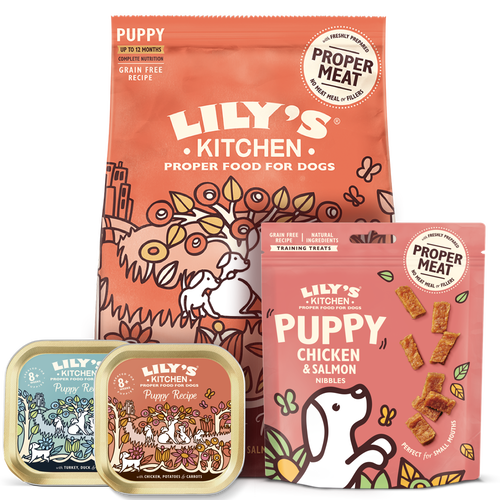
To help give your pup the best start in life, you need to feed them nourishing food containing everything your little one needs to support their growth. Lily’s Kitchen’s food for puppies has been specially formulated for growing pups with tailored nutrition to support their development (someone’s got to take on those puddles). Featuring recipes made with tailored levels of protein pups need to help them stay on top form, prebiotics to help support their digestive system, as well as vitamins and minerals. Bring on the puppy mischief.

The information in this article is intended as a guide to help pets and pet parents on their journey together. It is provided for educational and informational purposes only and is not meant as a substitute for professional advice from a vet, behaviourist, trainer or other professional. We encourage all pet parents to consult with their vet and/or behaviourist to ensure their pet’s specific needs are met.
Updated on 17/02/2026